
COB vs SMD Brightness: What’s the Difference and Which to Choose in 2026?
As LED lighting technology continues to evolve, two mainstream solutions dominate the market: COB LED strips and SMD LED strips. While both are widely used in residential and commercial lighting, they differ significantly in structure, performance, and application.When evaluating lighting options, understanding the nuances of cob vs smd brightness is crucial for choosing the right solution
This guide provides a complete comparison to help you choose the right lighting solution for your project.
1. Product Structure & Lighting Principle
COB LED Strip (Chip on Board)
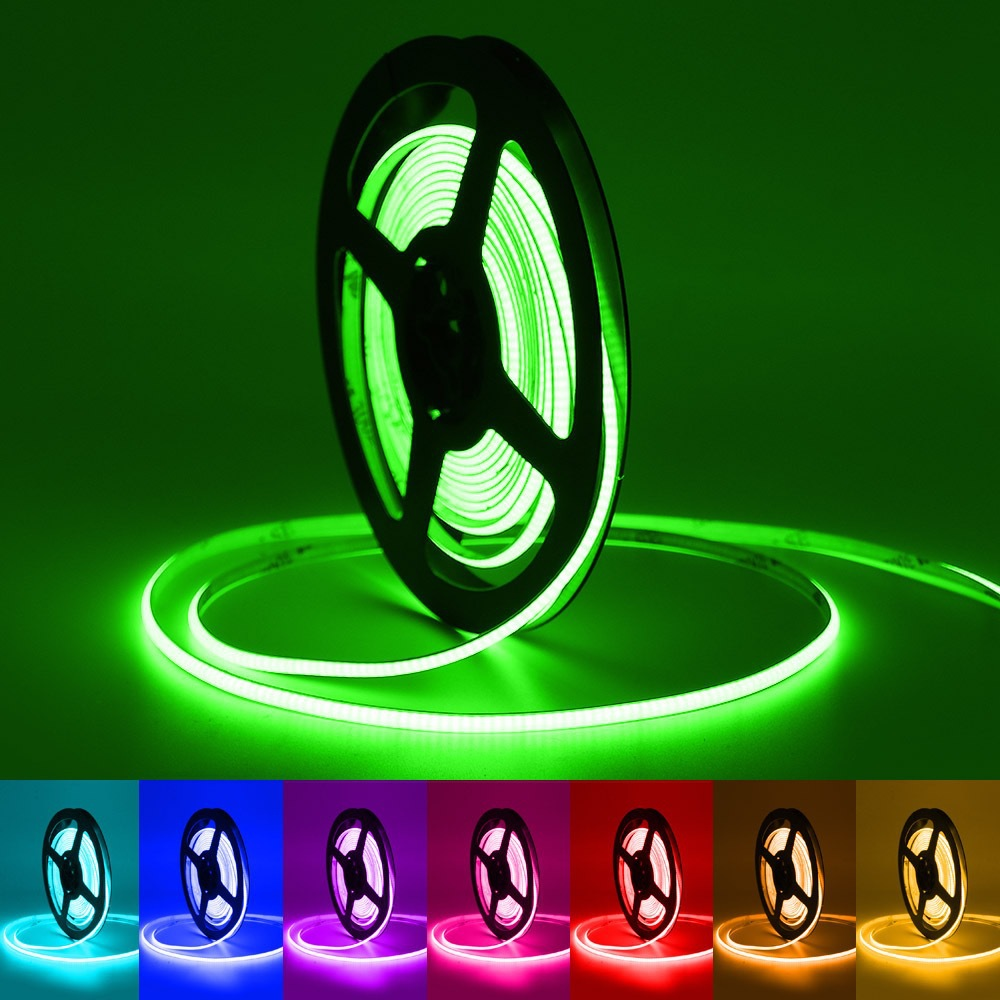
COB LED strips integrate multiple micro LED chips directly onto a flexible PCB (FPC). The chips are densely packed and covered with a phosphor silicone layer, creating a continuous, uniform light output without visible light spots.
Key Feature: Seamless linear illumination with no visible LED dots.
SMD LED Strip (Surface Mounted Device)
SMD LED strips use individual LED packages such as 2835, 5050, or 3014, mounted at fixed intervals on a flexible PCB. Each LED acts as a point light source, resulting in visible gaps between light points.
Key Feature: Discrete lighting points with noticeable spacing.
2. Key Specifications Comparison(cob vs smd brightness)
| Feature | COB LED Strip | SMD LED Strip |
|---|---|---|
| Light Output | Continuous linear light (no hotspots) | Point light with visible dots |
| LED Density | 320–528 chips/m | 30–120 LEDs/m |
| Beam Angle | 180° wide diffusion | 120°–180° directional |
| CRI (Color Rendering Index) | Ra ≥ 90 (up to 95–98) | Ra 70–80 (up to 90) |
| Glare (UGR) | UGR < 16 (low glare) | UGR > 22 (higher glare) |
| Cutting Length | 1–2 cm | 5–10 cm |
| Voltage | 12V / 24V | 12V / 24V / 220V |
| Luminous Efficiency | 100–120 lm/W | 120–160 lm/W |
| Power Consumption | 8–15 W/m | 4–12 W/m |
| Voltage Drop | Higher (short runs recommended) | Lower (long runs supported) |
| Flexibility | Very flexible, supports tight bends | Moderate flexibility |
| Heat Dissipation | Requires aluminum profile | Natural heat dissipation |
| Light Decay | Slow (encapsulated protection) | Faster in harsh conditions |
| Color Uniformity | Excellent, no color difference | Uneven mixing possible |
| Durability | Dustproof, moisture-resistant | Exposed LEDs prone to damage |
| Lifespan | 50,000+ hours | 30,000–40,000 hours |
| Dimming Performance | Smooth, flicker-free | Possible flicker at low brightness |
| Maintenance | Replace whole strip | Repair individual LEDs |
| Price | Medium to high | Low cost |
3. Key Differences Explained(cob vs smd brightness)
3.1 Lighting Effect
- COB LED Strip: Produces smooth, dot-free illumination with a premium, high-end appearance. Ideal for visible installations.
- SMD LED Strip: Visible LED dots and uneven light patterns at close range. Best for hidden lighting.
3.2 Installation & Flexibility
- COB: Short cutting intervals allow precise customization for corners and irregular shapes. Operates at low voltage for safety.
- SMD: Larger cutting intervals may limit flexibility. High-voltage versions simplify wiring but pose safety risks.
3.3 Environmental Performance
- COB: Fully encapsulated, offering excellent resistance to dust, moisture, and oil—ideal for kitchens and bathrooms.
- SMD: Open structure makes it more vulnerable to dust accumulation and aging.
3.4 Heat Management
- COB: High chip density leads to concentrated heat; requires aluminum channels for proper cooling.
- SMD: Better natural heat distribution; easier installation without additional heat sinks.
3.5 Smart Control Compatibility
- COB: Compatible with advanced dimming systems (0–10V, TRIAC, Bluetooth, smart home systems like Tuya and Mi Home), ensuring smooth transitions.
- SMD: Lower-end models may experience flickering and inconsistent dimming.
4. Advantages & Disadvantages(cob vs smd brightness)
COB LED Strip
Advantages:
- Dot-free, uniform lighting
- Low glare, eye-friendly
- High CRI and color consistency
- Flexible cutting and shaping
- Moisture and dust resistant
- Smooth dimming performance
- Safe low-voltage operation
- Premium aesthetic design
Disadvantages:
- Higher heat generation
- Requires aluminum profile
- Higher voltage drop
- Slightly lower efficiency
- Higher cost
- Needs segmented power for long runs
SMD LED Strip
Advantages:
- Higher brightness efficiency
- Energy-saving
- Better natural heat dissipation
- Lower voltage drop
- Suitable for long-distance lighting
- Cost-effective
- Easy maintenance
- Simple installation
Disadvantages:
- Visible light spots
- Higher glare
- Lower CRI (standard models)
- Prone to dust and aging
- Less premium appearance
- Flickering in low-end models
5. Application Scenarios(cob vs smd brightness)
Best Applications for COB LED Strips
- Modern minimalist lighting design
- Cabinet lighting and under-cabinet lighting
- Mirror lighting
- Skirting board lighting
- Shelf and display lighting
- Study rooms and bedrooms (eye comfort lighting)
- Decorative visible lighting
Best Applications for SMD LED Strips
- Concealed ceiling lighting
- Curtain boxes
- Corridor base lighting
- Outdoor lighting projects
- Large-area auxiliary lighting
- Budget-sensitive projects
- Long linear installations
- Indirect hidden lighting
Conclusion(cob vs smd brightness)
Both COB and SMD LED strips have their strengths.
- Choose COB LED strips for high-end, uniform, and visible lighting applications.
- Choose SMD LED strips for cost-effective, long-distance, and hidden lighting solutions.
Understanding these differences will help you optimize both lighting performance and project cost.
Contact us now for a quote or free sample.
(cob vs smd brightness)–Is COB or SMD LED strip brighter?
When comparing cob vs smd brightness, SMD strips can often achieve a higher maximum lumen output for high-power applications, but COB LED strips provide a much smoother, dot-free continuous brightness that eliminates harsh glare and shadows, making it visually superior for close-up linear lighting.
Which should I choose between COB and SMD LED strips in 2026?
Choose COB LED strips if you need seamless, uniform linear lighting where the light fixture is visible or reflected on surfaces (like aluminum profiles or glass). Choose SMD LED strips for budget-friendly projects, long-distance runs, or where maximum raw light output per watt is the primary goal.