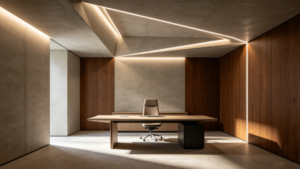

How to choose the COB LED strip lights for office ? Sitting in a brightly lit modern office from 9 to 5, do you often feel inexplicably tense, exhausted, or plagued by dry eyes and scattered focus before the afternoon even begins? The most common response from procurement managers or project designers is simply adding more brightness or cranking up the color temperature, believing that if 4000K isn’t working, upgrading to 5000K or 6500K cold white daylight will solve the problem.
This is a major misconception . What truly determines your daily energy, alertness, and eye strain is not how bright the room is, but the spectral composition of the LED strip lights for office and how light interacts with the space. Read more from CS-Tech to discover how choosing premium COB LED strip lights for office spaces can transform employee productivity and fulfill your commercial healthy lighting design criteria.
1. CCT is Not the «Whole Picture»: The Truth About Full-Spectrum LED Strips
In traditional office lighting procurement, Correlated Color Temperature (CCT) is usually the primary metric—such as 4000K for natural white or 5000K for cool white. However, CCT is merely a visual label for color tone; it cannot reflect how the human body biologically responds to that light source.
Human biology evolved under natural sunlight for millions of years. We feel energized outdoors because natural daylight delivers a continuous, rich, and well-balanced full spectrum. To understand how correlates to human biology, engineering buyers should study the scientific principles of ⧉ Correlated Color Temperature (CCT) & Visible Spectrum standards. Standard artificial light sources often have massive spectral gaps, lacking essential blue-green wavelengths or over-concentrating harmful high-energy shortwave blue light.
Modern commercial lighting design relies on specialized full-spectrum LED strip lights that mimic natural sunlight at a spectral level. This regulates melatonin secretion more safely and efficiently than adjusting CCT alone, significantly enhancing employee focus and reducing cognitive fatigue.
2. The Biological Impact: How Light Spectrum Dictates Focus
Why does the light spectrum dictate our daily stamina? Modern optometry reveals that the human retina contains a third class of photoreceptors called intrinsically photosensitive retinal ganglion cells (ipRGCs) . Instead of contributing to visual sight, they specifically track the 480nm blue-green wavelength to calibrate our internal biological clock.
2.1 Managing Fatigue with High-Frequency Cyan Light
Flooding open-plan workspaces with high-frequency blue-cyan wavelengths via embedded linear lighting during morning hours suppresses melatonin (the sleep hormone) while stimulating cortisol (the alertness hormone). This naturally activates the body’s wakefulness mechanism and sustains high mental agility.
2.2 The Structural Supremacy of Linear COB LED Strip Lights
Compared to traditional point-source downlights or spotlights that create uneven pools of light, streamlined COB led strip lights distribute illumination across a wider, more uniform plane. They eliminate harsh shadows and glare, generating a smooth «sky-dome» ambient effect. Implementing continuous COB LED strip lights for office applications minimizes the constant pupil adjustments required when workers look up from their screens, dramatically mitigating visual fatigue and spatial oppression.
3. Human Centric Design: Implementing Tunable White LED Strip Systems
An elite corporate workspace cannot rely on a single, static ceiling light fixture. Advanced commercial spaces require smart lighting that morphs throughout the day.
3.1 Enhancing Spatial Perception via Indirect Lighting
By utilizing premium LED light strips in wall-washing or ceiling cove installations, light is cast onto architectural surfaces first. This indirect reflection softens hard spatial boundaries, making cubicle zones feel visually expansive and structurally unconfined.
3.2 Dynamic Spectral Control from Dawn to Dusk
When finalizing your procurement for high-end interior architectural spaces, integrating a tunable white LED strip system that supports multi-channel intelligent controls is essential. The system shifts dynamically to provide physiological support across different work shifts:
Time Frame Recommended CCT Range Biological Objective & Ergonomic Benefit 08:00 – 12:00 5000K – 6000K Maximizes melatonin suppression; primes the body for active morning strategy sessions.
13:00 – 16:00 5000K → 4000K Combats post-lunch sluggishness; stabilizes mental concentration.
16:00 – 18:00 4000K → 3000K Gently slows down circadian rhythms; prepares employees for a relaxed end-of-day transition.
18:00 – 04:00 < 3000K Low-stimulus warm ambient light; fully protects subsequent sleep quality.
⚠️ Engineering Quality Baseline Checklist: Regardless of the control system chosen, desk surface visual illuminance must maintain a stable 300 to 500 Lux to remain bright without causing glare. Furthermore, in high-precision corporate offices, stroboscopic flicker must be eradicated. Invisible high-frequency flicker forces continuous ciliary muscle micro-adjustments, which is the leading hidden cause of unexplained headaches and chronic employee fatigue. Selecting high-frequency constant-current drivers is a non-negotiable standard for project compliance.
4. Maximizing ROI with Smart Zonal Lighting Layouts
Human Centric Lighting (HCL) rejects a uniform, one-size-fits-all color temperature across an entire facility. CS-Tech recommends a tailored zonal layout strategy:
4.1 Task-Oriented Workstations: Deploy high-CRI (evaluated under strict TM-30 and CRI metrics, $Ra > 95$), high-CCT, and flicker-free linear aluminum channel COB led strip lights. You can anchor internal weights by linking this structural step directly to our core Wholesale LED Strip Lights Category Page to evaluate factory-direct profile enclosures.
4.2 Lounges & Breakrooms: Install low-CCT warm-toned soft neon flex or dimmable accent lights (2700K – 3000K) within deep-recessed coves. This low-stimulus environment allows employees to reset mentally during coffee breaks, lowering burnout rates.
5. FAQ: Expert Answers to Commercial Office & COB LED Strip Lighting Queries
To help lighting designers and procurement managers make informed decisions, we have compiled scientific answers to the most frequently asked questions regarding office illumination and COB led strip lights:
Q1: Which is the best COB LED strip lights for office?
A: The best office lighting combines high color rendering (CRI Ra95+ / TM-30 metrics), high-frequency flicker-free performance, and a flexible layout. Instead of relying on a single overhead panel, full-spectrum COB led strip lights arranged in a linear aluminum channel provide the most uniform, glare-free vertical and horizontal light distribution. This structural approach closely mimics natural daylight, reducing workplace visual fatigue.
Q2: Is cool white or daylight better for office productivity?
A: Neither should be used exclusively; dynamic lighting is the ideal standard. High-temperature cool white (5000K – 6000K daylight) is highly effective for morning shifts (08:00 – 12:00) because its peak cyan-blue spectrum suppresses melatonin to keep teams focused. However, leaving cool white on all day causes optical strain. It is better to use a tunable white LED strip system that smoothly transitions toward a calmer 4000K or 3000K hue as evening approaches.
Q3: What is the difference between 3000K and 4000K LED strips?
A: The difference lies in their physiological and psychological impact:
4000K (Natural White): Delivers a crisp, neutral visual profile ideal for standard office workspaces, conference rooms, and collaborative areas to maintain steady focus.
3000K (Warm White): Provides a soothing, low-stimulus ambiance. It is best suited for corporate lounges, corridors, and transitional rest zones to lower stress and encourage relaxation.
Q4: Do LED lights affect circadian rhythms and cause office fatigue?
A: Yes, significantly. Human non-visual photoreceptors (ipRGCs) are deeply sensitive to the 480nm blue-green waveband. Standard, low-cost LED strips often suffer from a broken spectrum—either emitting an aggressive «blue spike» or lacking vital natural light components. This architectural flaw confuses our biological clocks, resulting in the headaches, mental fog, and afternoon sluggishness commonly blamed on long working hours. Upgrading to custom full-spectrum led cob light strips safely realigns workplace lighting with natural human biology.
Q5: Can I use colorful lights like cob led light strips rgb for office breakrooms?
A: Absolutely. Using low-voltage systems like 12V COB led strip lights or cob led light strips rgb in breakrooms and transitional lounges allows for creative, dynamic mood setting. It helps employees successfully switch their mindsets, effectively reducing the fatigue accumulated during long hours of intense work.
6. Future Outlook: Sourcing with the Certainty of CS-Tech
When shortlisting fixtures, sourcing high-quality COB LED strip lights for office projects requires attention to specific engineering baselines. In this fast-evolving landscape of 2026, forward-thinking enterprises view lighting systems not as static building materials, but as strategic investments in workplace health and organizational productivity.
Backed by our state-of-the-art 6,000-square-meter manufacturing base and 15 years of dedicated linear LED engineering, CS-Tech manufactures premium, commercial-grade 5V COB led strip light and high-voltage linear options that interface flawlessly with international sensors and DALI/0-10V control networks. Whether you need advanced COB led strip lights 120, flexible neon solutions, or customized office architectural profiles, we provide factory-direct pricing with flexible MOQs to support your business.
Don’t risk expensive commercial re-work. Contact our engineering team today to get expert product matching, sample kits, and a free wholesale quotation!