

The Ultimate Selection Guide & Pitfall Avoidance Scheme for Outdoor Lighting Projects
When planning outdoor landscape lighting, architectural facades, or water features, choosing the correct waterproofing level is the single most critical factor determining whether your project succeeds or requires costly post-installation maintenance.
In the commercial B2B LED lighting sector, the most frequent debate centers around IP67 vs IP68 LED strip lights. While they differ by only one digit, their internal structures, material compositions, and pressure tolerances are poles apart.
This comprehensive guide from CS-Tech (LEDStripFactory) will break down the technical differences between IP67 and IP68 waterproof ratings, highlight common procurement pitfalls, and help you select the ideal linear lighting solution to balance your project budget and long-term stability.
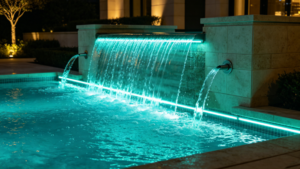
Before exploring our project guide, let’s understand why choosing the right IP67 vs IP68 LED strip matters.
1. Technical Definitions: What Are IP67 and IP68 LED Strip Lights?
Before diving into the comparison, let’s look at what the Ingress Protection (IP) ratings actually mean for linear LED lighting:
1.1 IP67 Waterproof LED Strips: Rainproof & Short-Term Immersion
The first digit “6” represents the highest dustproof rating, ensuring total protection against dust and particulate ingress. The second digit “7” indicates that the strip can withstand temporary immersion in water (up to 1 meter for 30 minutes).
-
Manufacturing Craft: Typically produced using silicone hollow sleeves or half-glue injection processes.
-
Best Used For: Heavy rain, strong winds, salt spray, and extreme temperature fluctuations. It is the industrial standard for building facades and general outdoor architectural lighting.
1.2 IP68 Underwater LED Strips: Long-Term Deep Water Immersion
An IP68 rating represents the gold standard for waterproof linear lighting. The digit “8” guarantees that the product remains completely functional under continuous submersion under specified water pressure.
-
Manufacturing Craft: Premium IP68 LED strips utilize solid gas-phase silicone integrated co-extrusion technology. There are zero air gaps inside the sleeve, eliminating the vacuum effect that sucks in moisture.
-
Best Used For: Swimming pools, aquariums, fountains, and marine projects where permanent, high-pressure water submersion is mandatory.
2. Core Differences: IP67 vs IP68 LED Strips Comparison
For B2B buyers, lighting designers, and electrical contractors, evaluating these two options requires looking past the datasheet. Here is how they compare across core operational metrics:
2.1 Water Pressure Resistance & Structural Integrity
-
IP68 LED Strips: Because they feature a solid, integrated extrusion with no internal air space, they easily resist continuous water pressure down to 2 meters deep. The internal PCB and LED chips remain perfectly stable, ensuring uniform, continuous light without dark spots or electrical failure.
-
IP67 LED Strips: Most standard IP67 strips feature a hollow tube or cavity design. Under continuous water submersion or high-pressure environments, the water pressure compresses the internal cavity. This deformation shifts the optical beam angle (creating jagged light spots/shadows) and can snap internal solder joints, causing premature LED failure.
2.2 Chemical Corrosion & Weather Resistance
-
IP68 LED Strips: Designed to survive harsh chemical environments. Swimming pools contain high concentrations of chlorine and disinfectants, while coastal projects face aggressive salt fog. High-quality IP68 silicone materials feature excellent chemical inertness and advanced anti-UV/anti-yellowing properties, ensuring they don’t crack or discolor over years of submersion.
-
IP67 LED Strips: Engineered for regular rainfall, dust, and sunlight. If permanently submerged in chlorinated or saline water, the outer jacket will degrade, harden, and crack over time. This leads to water ingress, causing short circuits on the PCB.
-

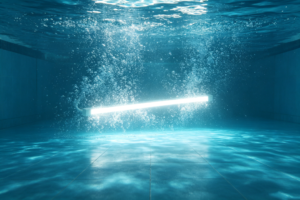
This side-by-side IP67 vs IP68 LED strip comparison clearly shows that their manufacturing processes serve entirely different water-exposure levels.
2.3 Safety, Cost, and Maintenance (IP67 vs IP68 LED strip)
| Core Feature | IP67 Waterproof LED Strip | IP68 Underwater LED Strip |
| Waterproof Definition | Temporary immersion; heavy rain protection | Continuous submersion; high-pressure resistant |
| Internal Structure | Hollow silicone sleeve / Half-glue injection | Solid integrated co-extrusion (No air gaps) |
| Voltage Standards | Supports both High Voltage & Low Voltage | Strictly Low Voltage only (12V/24V) |
| Procurement Cost | Highly mature technology; budget-friendly | Complex manufacturing; 30%–50% higher price |
| Installation & Cutting | Lightweight; easily cut at marked intervals | Heavier build; requires specialized waterproof connectors |
3. Project Selection Matrix: Which One Fits Your Scene?
To maximize your Return on Investment (ROI) and pass project inspections seamlessly, match your application to the correct rating:
3.1 Commercial & Landscape Engineering
Choose IP68 Underwater LED Strips For:
-
Commercial & Residential Swimming Pools: This environment combines permanent water immersion, heavy chlorination, and human contact. Low-voltage IP68 LED strips are legally mandatory here to ensure absolute electrical safety.
-
Fountains & Interactive Water Features: The high-frequency physical impact of moving water requires the shock-absorption properties of solid IP68 silicone extrusion.
-
Aquariums & Marine Lighting: Demands superior color consistency (SDCM < 3) and absolute resistance to saltwater corrosion.
Choose IP67 Waterproof LED For:
-
Municipal Building Facades & Roof Contours: These are exposed to the elements but never submerged. Industrial-grade IP67 LED strips paired with aluminum profiles offer the fastest, most cost-effective mass installation.
-
Bridges, Parks, and Handrail Lighting: Handles heavy downpours and temporary puddles easily while keeping the project within budget.
3.2 Interior Design & E-Commerce / DIY Retail
-
High-End RV & Automotive Underglow: Footsteps and under-car applications encounter high-pressure car wash sprays and heavy vibrations—making IP68 solid strips the most reliable choice to prevent warranty claims.
-
Bathrooms, Kitchens, and Covered Patios: These experience high humidity and occasional splashes. A 24V IP67 LED strip offers the perfect balance of safety, easy DIY installation, and affordability for global consumers.
When finalizing your procurement for an IP67 vs IP68 LED strip, avoiding common implementation mistakes is vital for project safety.
4. 3 Critical Pitfalls to Avoid in B2B LED Strip Procurement
Pitfall 1: Using High-Voltage Strips Underwater
Never use high-voltage (110V/220V) LED strips in or around water features where humans or animals are present. Low-voltage 12V or 24V systems connected to isolated safety transformers are the absolute baseline for engineering safety audits.
Pitfall 2: Overlooking Power Supply Redundancy
Whether installing IP67 or IP68 systems, always leave a 20% power redundancy margin for your LED drivers. Running power supplies at 80% maximum capacity cushions the system against current spikes, reduces heat, and significantly extends the lifespan of your LED strips.
Pitfall 3: Sourcing Without Globally Recognized Certifications
For international engineering projects and cross-border distribution, missing compliance documents will halt your customs clearance or fail local building inspections. Always verify that your manufacturer can provide valid UL, CE, RoHS, SAA, and ErP certification copies.
Why Partner with CS-Tech (LEDStripFactory)?
As a premier OEM/ODM manufacturer specializing in linear LED lighting for over 15 years, CS-Tech operates a state-of-the-art 6,000-square-meter production base. We are recognized as a national high-tech enterprise, delivering reliable, certified, and high-performance lighting solutions across the globe.
Whether you need High-CRI (Ra95+) COB LED strips, custom-length Digital RGB Neon Flex, or heavy-duty IP68 underwater solutions with factory-direct pricing and flexible MOQs, our engineering team provides end-to-end support from blueprint to installation.
📥 Need a Reliable Waterproof Lighting Solution for Your Next Project?
Don’t risk expensive commercial re-work. Contact our engineering team today to get expert product matching, sample kits, and a free wholesale quotation.


