

How to Choose the best COB LED Strips ?
12V vs 24V vs 48V COB LED Strips: Which One is Best for Your Project?
When sourcing COB (Chip on Board) LED strips for your projects, parameters like color temperature, wattage, and IP rating usually top the checklist. However, one critical factor is frequently overlooked: the working voltage.
Many procurement managers and electrical installers mistakenly assume that 12V and 24V are just different powering methods with no real practical differences. But in professional engineering projects, your voltage choice directly impacts run distance, brightness uniformity, installation costs, and long-term maintenance stability.
The Technical Core: It’s All About Current
From a pure light output perspective, a 12V COB LED strips and its 24V or 48V counterparts deliver the exact same brightness and seamless, dot-free linear effect. The real difference lies in the current (amperage) flowing through the flexible PCB.
At the same wattage, a lower voltage (12V) requires a much higher working current, whereas higher voltages (24V and 48V) require much less current. Lower current means significantly lower voltage drop and line loss through the copper traces, allowing for longer continuous runs without a drop in illumination.
3 Critical Factors to Consider Before Buying
1. Voltage Drop & Brightness Uniformity
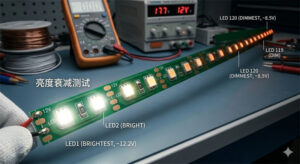
Voltage drop is the number one enemy of professional lighting installations. If you feed power from only one end of a 10-meter 12V COB LED strips, the line loss will gradually increase, and the brightness will visibly fade toward the tail end. A 24V or 48V system experiences far less voltage drop, maintaining flawless brightness consistency from the first inch to the very last.
2. Total System Cost (The Hidden Procurement Trap)
Many buyers only compare the price per meter of the LED strip itself, ignoring the hidden costs of the entire power supply network.
- 12V Systems: Because of the high current and severe voltage drop, you will need more power injection points, thicker copper wires, and additional LED drivers. This inflates both material expenses and installation labor.
- 24V & 48V Systems: These systems drastically reduce the number of power injection nodes. For large-scale commercial layouts, the total project installation cost is often significantly lower.
3. Cutting Flexibility & Precision
While higher voltages win on long runs, 12V holds a distinct advantage in tight spaces. Because its internal circuit groups are shorter, 12V COB strips feature much smaller cutting increments (intervals). This offers superior installation flexibility when precise, custom lengths are mandatory, ensuring the strip fits perfectly without dark corners.
Deep Dive: Real-World Application Scenarios
To help you avoid mistakes on the job site, let’s look at specific blueprints where choosing the wrong voltage can ruin a project:
1. Where 12V COB LED Strips are Unreplaceable
- Custom Retail Display & Jewelry Showcases: A high-end watch or jewelry boutique needs seamless lighting inside glass display cubes that are only 40cm x 40cm. Space is extremely tight. A 24V or 48V strip might have a cutting unit of 5cm or 10cm, leaving dark shadows at the corners if it doesn’t fit perfectly. A 12V COB strip has a smaller cutting unit, allowing installers to wrap the light precisely around the frame with zero dark spots.
- Luxury RV & Marine Interior Refitting: Upgrading ambient lighting under beds, steps, and ceilings inside a luxury motorhome or private yacht. These vehicles run entirely on a 12V DC battery bank system. Using 12V COB strips allows you to connect the lighting directly to the vehicle’s fuse box without adding bulky voltage converters.
2. Where 24V COB LED Strips Dominate (The Contractor’s Choice)
- High-End Residential Ceiling Coves: A modern living room requires a continuous, hidden light cove around the entire perimeter, spanning roughly 5 to 10 meters per wall. If you use 12V, you would have to run separate power feed wires to multiple points of each wall to avoid a dim tail end. With 24V COB, you can power a full 10-meter run from a single power supply hidden in the AC maintenance hatch, ensuring perfectly uniform light with half the wiring labor.
- Hotel Corridor & Commercial Interiors: A hotel hallway stretching 50 meters needs continuous floor-level wall washing, linear office fixtures, or baseboard lighting. 24V strikes the perfect balance between cost and performance. It allows installers to place a high-power driver every 10 meters inside the drywall, standardizing the installation process and keeping the bill of materials (BOM) highly competitive.
3. Where 48V COB LED Strips Win (Large-Scale Commercial)
- Airport Terminals & Double-Height Lobbies: A commercial shopping center atrium or airport terminal with high ceilings requires a continuous vertical or overhead light line that runs 20 meters without interruption. At 20 meters, a 24V strip would require multiple power injections, meaning visible wires or external drivers every few meters, which ruins the clean architectural look. A 48V COB strip can easily run 20 meters on a single power feed, keeping the ceiling clean and reducing maintenance points.
- Modern Smart Office Magnetic Track Systems: An open-plan office utilizing a modular magnetic track system on the ceiling, where floodlights, spotlights, and linear COB strips need to be moved around freely. 48V is the standard infrastructure for smart magnetic tracks (like Tuya, Casambi, or DALI systems). It delivers enough power over long track runs to support multiple high-wattage fixtures simultaneously while keeping the current low enough to safe-to-touch levels.

Frequently Asked Questions (FAQ)
Q1: Is a 24V or 48V COB LED strips brighter than a 12V strip?
No. Voltage does not determine brightness. Brightness is determined by the LED chip efficiency, density, and power consumption (wattage per meter). A 24V strip just maintains its maximum brightness over a longer distance compared to a 12V strip.
Q2: Can I connect a 12V COB LED strips to a 24V power supply?
Absolutely not. Connecting a 12V strip to a 24V or 48V power supply will immediately overload the circuits, cause severe overheating, and permanently burn out the LED chips. Always match the strip voltage with the driver output voltage.
Q3: Why does 48V require thinner gauge wires than 12V?
Because of the higher voltage, the current needed to deliver the same power is much lower. Lower current means less heat generation, allowing installers to use thinner, more cost-effective power cables while complying with building safety codes.
Q4: Which voltage is safest for residential DIY?
Both 12V and 24V fall well within the Safety Extra Low Voltage (SELV) range, meaning there is zero risk of harmful electrical shock during installation or daily use. 48V is also considered safe for indoor installations but is more commonly handled by professional contractors.
Final Procurement Summary
Metrics12V COB Strip 24V COB Strip 48V COB LED Strips Max Single Run (Single-End Power)Short (Approx. 5m)Medium (5m – 10m)Long (15m – 20m+)Cutting Unit PrecisionHighest (Very short interval)ModerateLower (Longer interval)Required Wire GaugeThickest / Heavy DutyStandardThinnest / Most Cost-savingEcosystem & Dimmer ChoicesAbundantHighly Abundant (Mainstream)GrowingProject Total CostHigh for large projectsHighly OptimizedLowest for ultra-long projects
When finalizing your product selection, understanding the specific installation layout and continuous wiring distances is far more critical than simply comparing the unit price per meter.
As a dedicated manufacturer specializing in high-density COB and CSP LED solutions for overseas commercial lighting and engineering clients, we supply top-tier voltage-matched systems. We look at your blueprints to help you balance impeccable brightness uniformity with minimized systemic overhead.
Get in touch with our technical sales team today to receive a comprehensive power distribution scheme and an exclusive volume quote for your upcoming project!


